Abstract
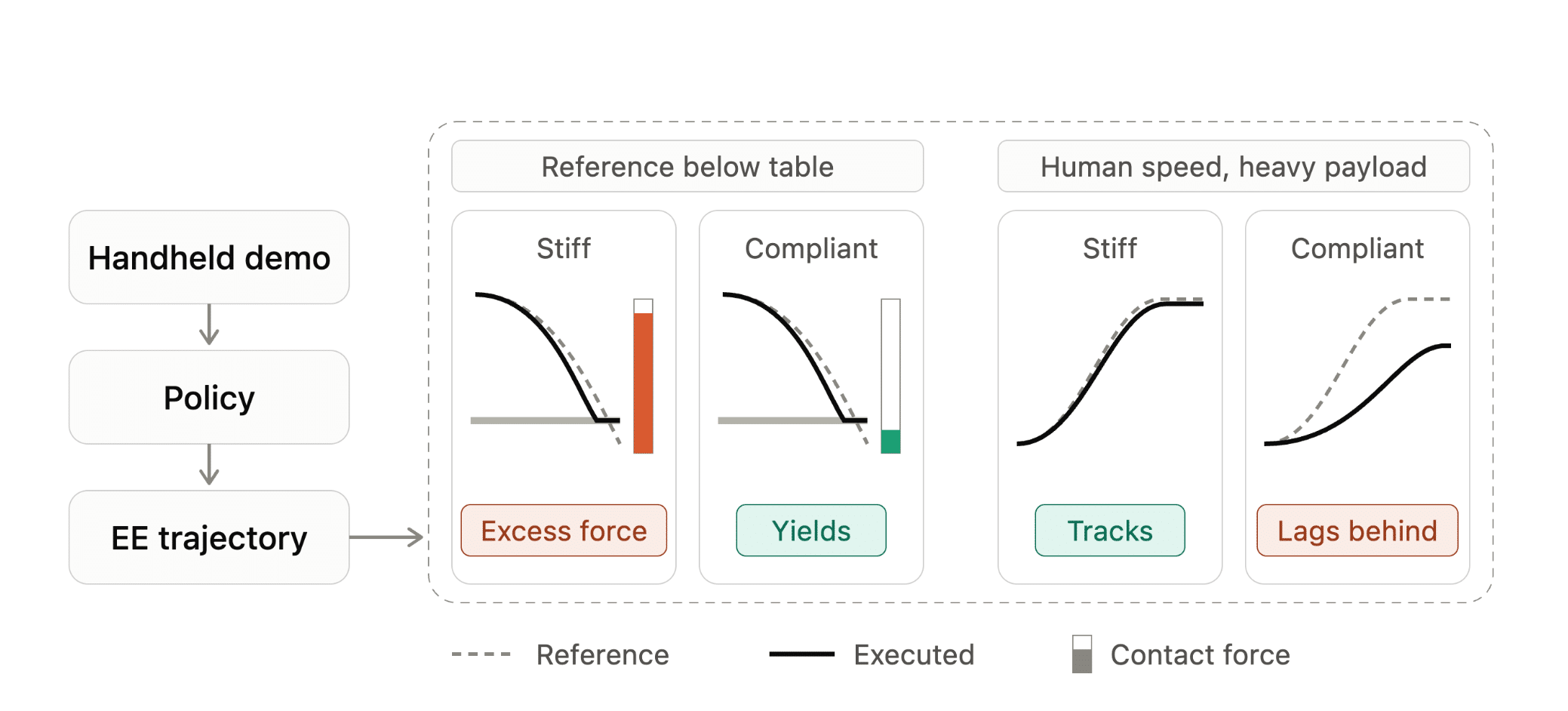
Handheld data collection systems such as the Universal Manipulation Interface (UMI) enable scalable data collection across environments but capture only observed actions rather than the desired actions sent to a robot controller. Teleoperation captures desired actions directly but is slow to collect. We revisit this trade-off through the lens of action validity across task phases; handheld trajectories provide valid supervision in tolerant, free-space phases, but lack dynamic feasibility in contact-sensitive phases, where tracking observed trajectories at high stiffness produces large, unsafe contact forces. Rather than teleoperating entire tasks, we collect a small number of targeted teleoperated demonstrations only for segments where handheld policies fail. However, naively mixing the two data types performs worse than handheld data alone. We therefore propose Bi-modal Routing for Imitation Data via Gated Experts (BRIDGE), a mixture of diffusion policy experts that routes between specialist heads conditioned on the current robot state. BRIDGE improves success rates over handheld-only baselines by up to 36.7% across three contact-rich tasks. See our project page for videos.